







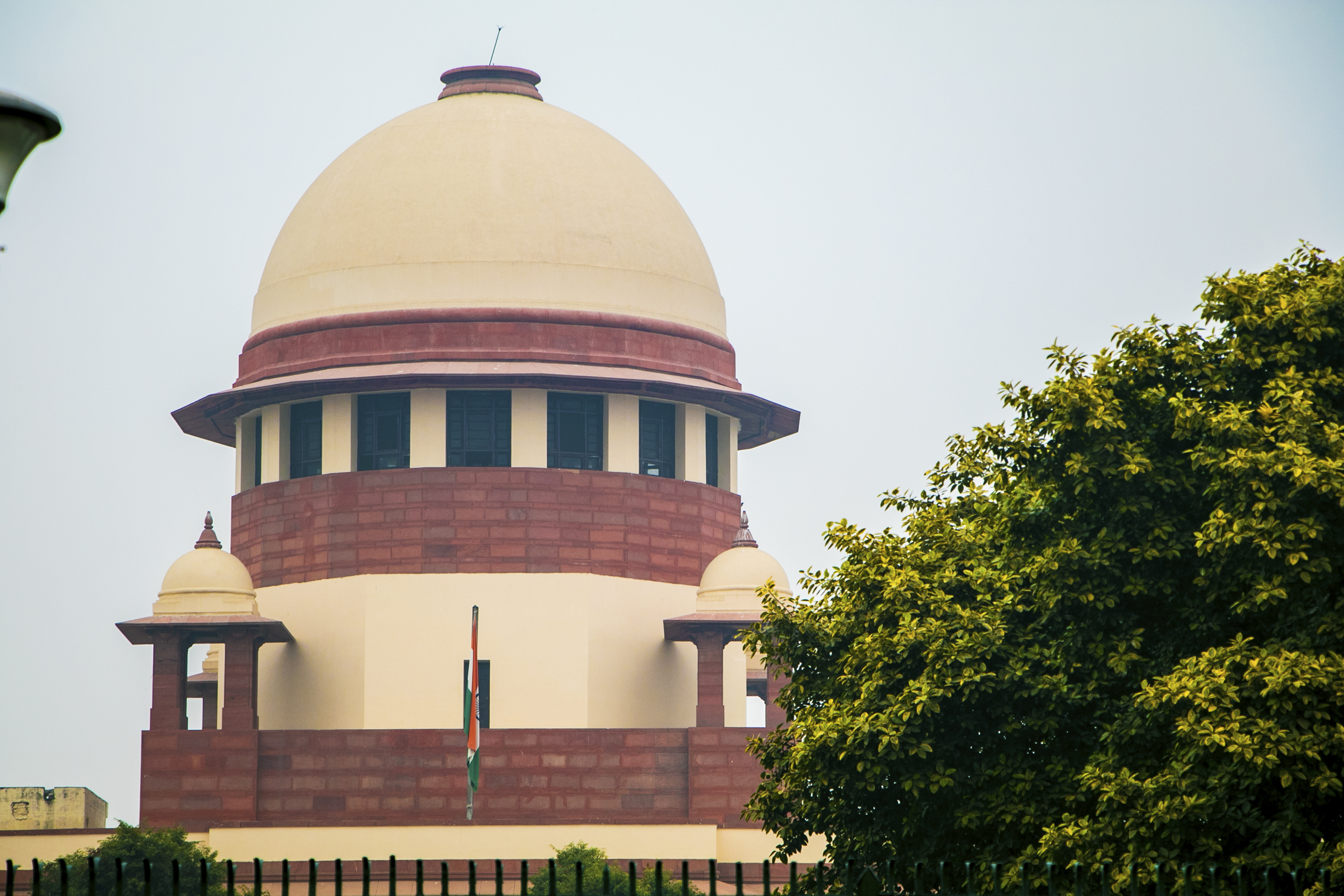
New Delhi: The Supreme Court on October 15 directed the Centre to set up a national database of child sexual exploitation and abuse material (CSEAM) so that sexually explicit visual content depicting minors can be detected and removed across all digital platforms in a coordinated manner.

The order, passed by a bench of Justices J.B. Pardiwala and K. Vinod Chandran and made available on October 17, runs to 137 pages and lays down an elaborate technological and legal framework to combat the circulation of such material on the internet.
The direction came while the court was hearing applications filed by the child rights NGO Just Rights for Children Alliance, which pointed to an alarming rise in child sexual exploitation and abuse material circulating on social media. The petitioners argued that intermediaries were failing to meet their legal obligations to report such material to Indian authorities and sought uniform reporting procedures, a centralised portal, and action against platforms that do not comply.
Senior advocate H.S. Phoolka appeared for the NGO.
In its order, the bench said the government must create a national repository containing hash identifiers and URLs of confirmed abusive material. A hash identifier is a unique digital fingerprint of an image or video, which allows platforms to recognise the same content even when it is re-uploaded from a different source.
By maintaining a shared database, the court said, social media intermediaries would be able to cross-check problematic content against a common reference instead of relying only on their own internal systems.
The court noted that the current arrangement suffers from a lack of coordination. When one platform detects and removes abusive content, the same material is not automatically flagged and taken down elsewhere, since each platform works in isolation. Because the existing mechanism depends on individual complaints and case-by-case reporting, removal is often delayed and the material is never fully eliminated from the internet.
The national database is meant to plug precisely this gap.
The bench was careful to underline that the database must not hold the harmful content itself. It will carry only the hash identifiers and the URLs of confirmed CSEAM. The URL listings will help platforms identify internet addresses hosting such material so that access to them can be blocked.
The court suggested that the repository could either be built into the existing Sahyog portal — the government's framework for issuing content-blocking directions to intermediaries — or established as a standalone database.
To guard against mistakes, the court ordered a multi-layered verification process. Each entry in the database must pass through several levels of screening, combining technological tools with human judgment. While specialised software may be used for preliminary screening, the final determination on whether material qualifies as CSEAM must be made by at least three trained human analysts, each assessing the material independently.
The court further ordered safeguards against erroneous entries: records of assessments must be maintained, access to the database must be logged, periodic independent audits must be conducted, and incorrect entries must be removed promptly so that lawful content is not affected.
Beyond the database, the bench imposed direct obligations on social media intermediaries. It declared that every intermediary must ensure that no CSEAM, or any other material likely to harm children, is offered, hosted, uploaded, promoted or circulated through paywalled or subscription-based services, directly or indirectly.
The court asserted that platforms must answer to local law enforcement under Indian law rather than merely removing content or reporting it to foreign organisations. Intermediaries were directed to report harmful content to the Special Juvenile Police Unit, local police, or the cybercrime portal, as required under Rule 11 of the Protection of Children from Sexual Offences (POCSO) Rules, 2020, within the prescribed timelines.
The court set strict reporting clocks. Where an intermediary removes abusive material of unknown origin through its own due diligence, it must report the removal within two hours. Where the removal follows a user complaint, the report must be filed forthwith after the complaint is resolved — and in any event within two hours of such resolution. Removal actions must then be followed by consolidated weekly reports to the authority that will maintain the national database.
Intermediaries were also directed to display the details of their grievance officers and complaint mechanisms clearly on their websites and applications. There must be a distinct, easily accessible reporting category for complaints concerning CSEAM. Complaints have to be acknowledged within 24 hours with a reference number, and complainants must be informed of the decision along with the reasons.
Preliminary screening of complaints would be done by trained grievance officers assisted by automated tools.
For enforcement, the court directed the Centre to bring in appropriate amendments to the Information Technology Rules so that the new framework has teeth. The upgraded regime must provide for exemplary monetary penalties on intermediaries that breach their obligations under the IT Act and the IT Rules, with the quantum of penalty calibrated to the gravity, duration and recurrence of the default and the turnover of the intermediary.
The Centre, acting through the Ministry of Electronics and Information Technology and the Ministry of Law and Justice, was asked to frame the necessary guidelines, standard operating procedures and rule amendments, and to file an affidavit detailing implementation progress by December 10, 2026, the date fixed for the next hearing.
The bench also turned its attention to paywalled and subscription-based content, which it said needs rigorous scrutiny to ensure that abusive material is not hosted, promoted or circulated behind paywalls. The Centre was asked to frame guidelines for examining such content and to consider whether the framework should provide for forfeiture of the money intermediaries earn from the circulation of CSEAM through paywall or subscription services.
Significantly, the bench refused to treat the internet itself as the problem. It held that the right to access and use the internet is a fundamental right of every individual under Article 21 read with Article 19(1)(a) of the Constitution, covering children as well. A blanket ban on children using the internet, the court said, would be disproportionate and would mistake the victim for the problem.
The bench recalled that its January 2020 judgment in Anuradha Bhasin vs Union of India had protected the freedom of speech and expression through the internet under Articles 19(1)(a) and 19(1)(g), and that the April 2025 decision in Pragya Prasun & Ors. v. Union of India had held digital access to be an intrinsic component of the right to life under Article 21.
The wrongdoer, the court stressed, is the person who creates, circulates, sells or seeks out such material, and the intermediary that fails to detect and remove it.
That did not mean unrestricted access for children, the bench clarified. It suggested age-based safeguards centred on greater parental consent, guidance and supervision for children's social media accounts, along with a dedicated child mode carrying measures proportionate to the objective of safety.
It also recommended that children's accounts be private by default, with restrictions on contacts and messages from unknown adults and moderation of the advertising and content accessible to children.
The court observed that experience in other jurisdictions shows children do not stop using the internet merely because the law tells them to; they simply move to unregulated and even more unsafe corners of the web, often without their parents' knowledge, and fear of punishment makes them reluctant to report exploitation.
The judgment also looked to education. The court said children should be taught age-appropriate lessons on consent, safe and unsafe touch, healthy relationships, protection of personal data, online exploitation and the mechanisms available for reporting abusive conduct.
Digital safety and age-appropriate education should be part of the core curriculum, with the National Council of Educational Research and Training and the State Councils developing the syllabus in consultation with child psychologists, educators and parenting experts.
The order is the latest chapter in a series of directions the court has issued on this subject. In September 2024, in the case of Just Rights for Children Alliance & Anr. v.
S. Harish & Ors., the Supreme Court had already passed directions on the menace of child sexual abuse material, including the significant ruling that viewing, downloading or storing such content amounts to an offence under the POCSO Act and the IT Act, and it had asked Parliament to consider replacing the term "child pornography" with "child sexual exploitative and abuse material" to reflect the gravity of the crime.
The present order builds on those directions, noting with concern that such material continues to circulate online despite them.
The bench's directions now place the onus squarely on the government and the platforms: a verified national database, time-bound reporting, accountable grievance redressal, penalties for defaulters, and a compliance affidavit before the court by December 10. How swiftly the ministries frame the guidelines and amend the IT Rules will determine whether the framework moves from judicial direction to functioning reality.
(Reporting based on The Indian Express and OpIndia.)